Content index
At Guala Dispensing, we are always looking for more sustainable coffee capsules. To validate our development choices with objective data, we recently commissioned a product carbon footprint (PCF) study. It tells a more complete story, one that looks at manufacturing, raw materials, and end of life together, rather than any single factor in isolation.
As an empty coffee capsule manufacturer and supplier, this kind of data shapes how we design every capsule we bring to market. Here is what the study shows, and why it matters for sustainable capsules going forward.
A more sustainable manufacturing footprint
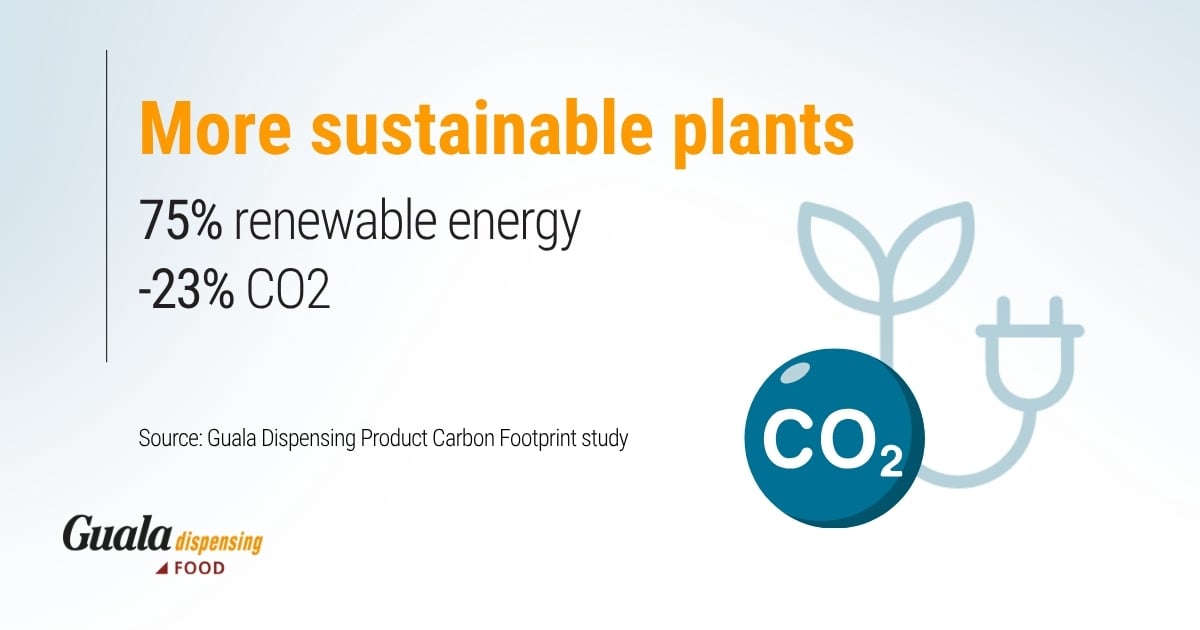
Before looking at the capsule itself, it is worth starting with the factory floor.
Guala Dispensing's Food and Pharma manufacturing carbon footprint dropped 23% after shifting to renewable electricity, which now covers 75% of electricity purchased from our production site.
This figure applies to the full scope of the plant production, not to any single capsule or product line. It reflects an investment in how things are made, independent of what they are made from. More detail on our energy, water, and waste performance is available in our latest Sustainability Report.
Lightweighting as an eco-design principle
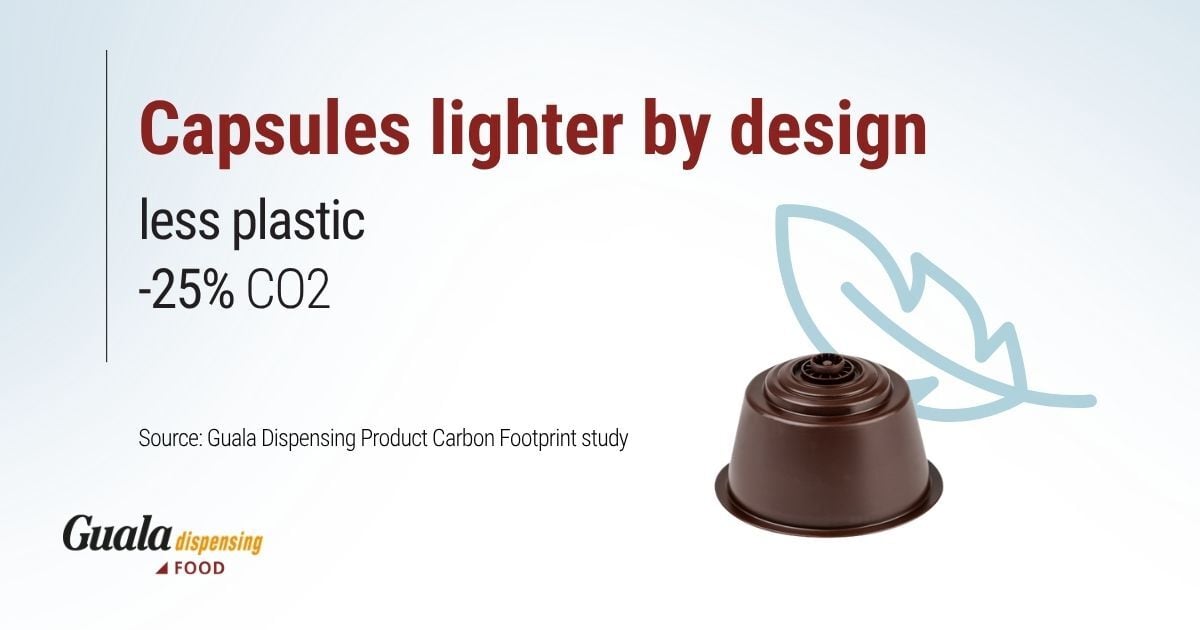
Lightweighting cuts a capsule's raw material emissions by around 25%. Our newer generation of plastic capsules achieves this reduction compared to earlier standard designs, without a change in material family.
This is not a marginal gain. Removing weight from a component that is produced in the billions has a compounding effect on emissions long before the capsule reaches a coffee machine.
It is also one of the more direct levers available in packaging design: less material in, less carbon out.
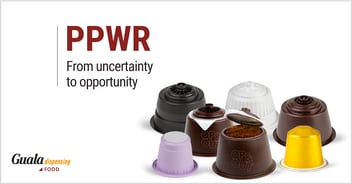
Our Dolce Gusto®-compatible range spans exactly this spectrum, from non-barrier capsules such as Supera to the lightest version of Ultra, with barrier. OP&OUT in turn, combines lightness with the ability to open it up for emptying.
Recyclable design and the end-of-life advantage
.jpg?width=1200&height=630&name=Co2%20(3).jpg)
Recyclable, mono-material capsules cut end-of-life emissions by more than 75% compared to standard multi-material designs.
How our capsules compare
The study covered several generations of our Dolce Gusto®-compatible range, each representing a step in the same direction: less material, and a cleaner end of life.
|
Capsule |
Description |
End-of-life design |
|---|---|---|
|
PP, non-barrier, lightest on the market |
Standard recovery |
|
|
PP-EVOH-PP, barrier, lightweighted |
Standard recovery |
|
|
PP-EVOH-PP, monomaterial, barrier, openable |
Openable for grounds separation, improved material recovery |
Each generation builds on the one before it. Lighter construction reduces raw material emissions, and monomaterial, openable design reduces end-of-life emissions, the two levers behind the 25% and 75%+ reductions covered above.
What this means for capsule design
Taken together, the findings point in one direction: sustainability gains in coffee capsules come from compounding smaller improvements rather than any single breakthrough. Renewable energy in manufacturing, lighter capsules through reduction in material use, and recyclable end-of-life design each contribute a measurable reduction, and together they add up to a meaningfully lower footprint across the full lifecycle of the product.
For an empty coffee capsule manufacturer and supplier, this is the standard sustainable capsules are now measured against: not a single eco-friendly claim, but a full lifecycle that holds up under scrutiny at every stage. It is also the direction set by the EU's Packaging and Packaging Waste Regulation, which now classifies coffee capsules explicitly as packaging.
Want to find the capsule that best fits your product, and see the specific carbon footprint data behind it? Get in touch with our team.
*Nespresso® and Dolce Gusto® are registered trademarks of their respective owners, referenced here for compatibility purposes only.